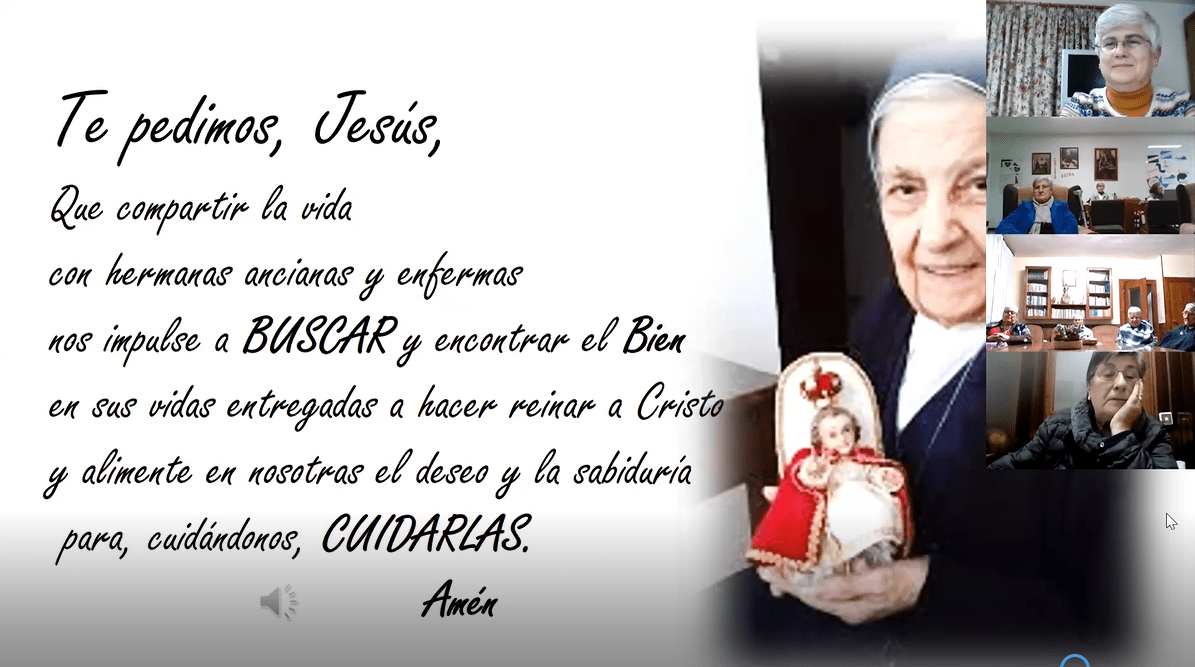
From the General Government, a new wealth to receive: The conferences “Accompanying our sisters in the fragility”, celebrated on November 13 and animated by Mª Rosa AbadSister Hospitaller, Mª Rosa filled our hearts with her experience and left us with projects of change and lights to improve on a personal and community level in this area.
Intense day, opening the mental and emotional horizon, in which basic concepts and attitudes of self-denial based on understanding and affection were clarified. I could summarize by saying that “We have an enormous responsibility in our eyes”. Looking, recognizing by name and stopping the accelerated pace that we follow when we meet a sister, can help us detect in her a certain “COGNITIVE IMPAIRMENT” (which is nothing more than certain memory losses) on which we can work and thus avoid it becoming “DEMENTIA” (at this stage the person would already be limited in memory, thinking and social skills, reaching the point of totally incapacitating them for the basic activities of life). What responsibility we have in what we see!
In this type of accompaniment, we must always keep in mind the question: How would I like to be treated? Even if a sister behaves like a child, we should treat her like an adult. The “sister” must always be above the problem, her dignity as a person is sacred. Given this, Mª Rosa put a lot of emphasis on the qualities necessary to accompany the fragility of the sick sisters, since mere “good will” is not worth it, which represents a leap of personal honesty. To care you need:
Compassion in the sense of “WITH – PASSION”.
COMPETENCE: Train to know how to do things.
CONFIDENTIALITY: Respect for privacy and that what is entrusted is not an object of exhibition.
TRUST.
All this without forgetting that in order to take care of yourself, you first have to take care of yourself. The physical, emotional and mental health of the sister you care for is of vital importance. A person who does not take care of himself will hardly be able to take care of himself. Care has to do with the use of free time for personal benefit (walking, reading a book, physical exercise, watching a sunset, meeting loved ones...). Our most fragile sisters need the presence of sisters, but calm presences that touch and dignify, that make them feel that they exist, that transmit affection and that disconnect them from the mental silence and emptiness that they may have.
“Old age is the only thing that comes without having to make an effort”, Cicero said, but you do have to make an effort to live it in such an adequate way that when you reach it, When they ask us: What profession do you have?, we can say: HAPPY.
May this very sacred stage of life be, for all of us, a priority even though society has ruled it out and that training in all of this is present from the beginning. God must bless us for so much good that we seek with our sisters.
Pili Vargas, HCR